


Innovation and water resource protection at the heart of the training day for the agricultural sector
19 February 2026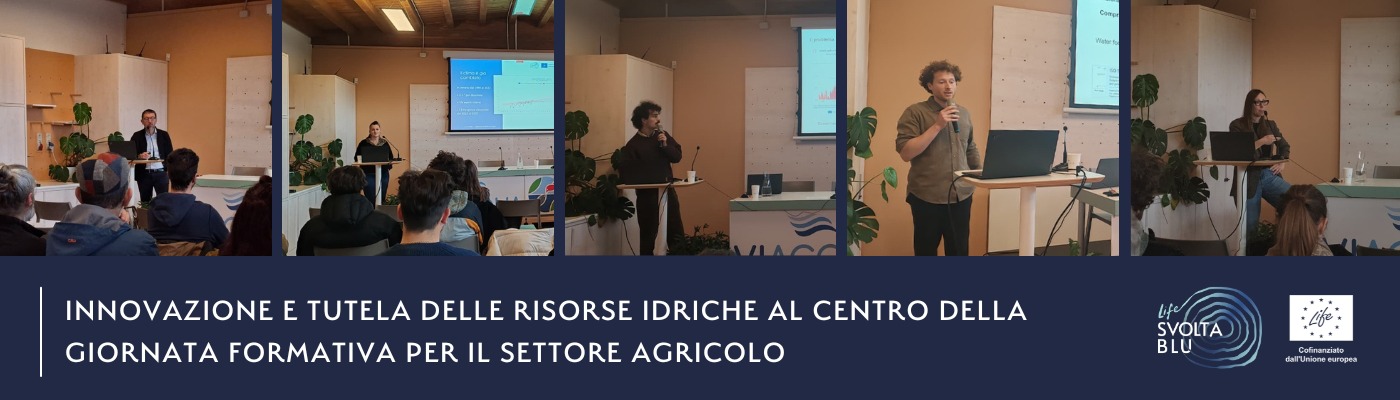
On 10 February 2026, a training day dedicated to sustainable water management in agriculture took place at the Risorgive del Bacchiglione in Dueville (Vicenza), with the possibility to participate remotely. The event was organised as part of the LIFE Svolta Blu project and co-funded by the European Union.
The initiative brought together agricultural enterprises, technicians, and local stakeholders for a practical and strategic discussion on one of the most urgent challenges facing the primary sector: protecting and using water resources efficiently in the context of climate change.
Climate change and pressure on water resources
In recent years, Northern Italy has experienced a progressive reduction in groundwater recharge, increasingly irregular rainfall patterns, and prolonged drought periods. Rising temperatures and intensified evapotranspiration are placing significant pressure on the entire water system. In this scenario, agriculture is not only one of the most exposed sectors, but also one of the key actors in driving change.
Through innovative practices and more conscious management, agricultural enterprises can:
-
Reduce water withdrawals
-
Improve irrigation efficiency
-
Increase the soil’s capacity to retain water
-
Promote groundwater recharge
The training day highlighted that sustainable water management is no longer an optional choice, but a necessary condition to ensure economic, environmental, and productive resilience.
From scientific knowledge to practical applications
The course combined scientific foundations with practical tools, offering participants solutions that can be immediately integrated into farm management.
Among the topics addressed:
-
The hydrogeological framework of the territory and risks related to water availability
-
Measuring crop water requirements in relation to soil characteristics
-
The use of efficient irrigation techniques and sensor systems to optimise consumption
-
The creation of on-farm micro-reservoirs for collecting and retaining rainwater
-
Practices that support groundwater recharge
-
Successful examples of regenerative agriculture already implemented
The approach demonstrated that innovation does not necessarily require radical transformations. Instead, it can be achieved through the gradual integration of smart technologies and good practices into everyday agricultural management.
The innovative water credits system
One of the most innovative elements presented during the meeting was the water credits system (“blue credits”).
Within the LIFE Svolta Blu project, virtuous actions, such as reducing water consumption, restoring wetlands, or implementing infiltration systems, can generate measurable environmental benefits. These benefits can then be translated into credits and introduced into a local trading system.
This mechanism represents a paradigm shift: it recognises the economic value of ecosystem services provided by agricultural enterprises and creates a concrete incentive for adopting sustainable practices.
The training day was not only an educational opportunity, but also a moment of dialogue and shared awareness. Water management cannot be addressed in isolation; it requires cooperation among businesses, institutions, and local communities.
Only through coordinated action will it be possible to ensure the long-term sustainability of water resources and strengthen the resilience of the agricultural sector.
Explore the project
 Italiano
The LIFE Svolta Blu project is funded by the Climate Governance and Information sub-programme of the EU’s LIFE programme, under contract number 101157983 - LIFE23-GIC-IT-LIFESVOLTABLU.
 Funded by the European Union. The views and opinions expressed are those of the authors only and do not necessarily reflect those of the European Union or CINEA. Neither the European Union nor CINEA can be held responsible.