


New Tools to Finance Water Protection: LIFE Svolta Blu Brings Water Credits to the EuroMediterranean Water Forum
09 October 2026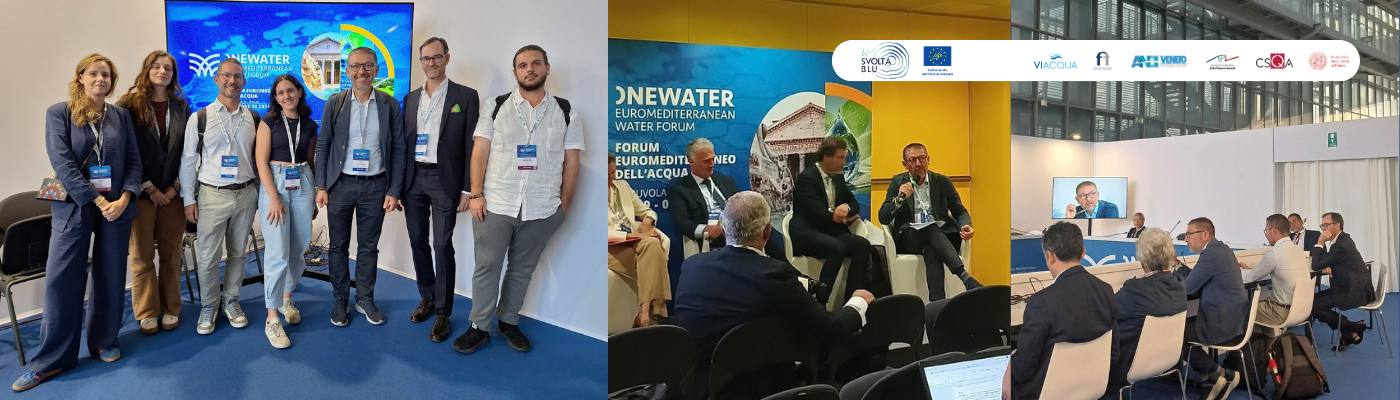
On 30 September 2026, LIFE Svolta Blu brought the experience developed in the Vicenza area to the EuroMediterranean Water Forum 2026, held at the La Nuvola Convention Centre in Rome. The project participated in two discussions focusing on the role of finance and the private sector in developing new models for more sustainable water resource management.
During the morning session, “Blue Finance and Blue Investment for Water”, Paolo Ronco, Head of Research and Innovation at Viacqua and Scientific Coordinator of LIFE Svolta Blu, presented the blue credits model developed by the project, engaging with institutional representatives, experts and water sector professionals from different countries.
The panel addressed one of the main challenges facing the future of water management in the Mediterranean: a structural investment gap estimated at between USD 40 and 80 billion per year. This funding need takes different forms across the Mediterranean region. On the European shore, investments are primarily required to modernise existing infrastructure, reduce water network losses, tackle emerging contaminants such as PFAS, and accelerate digitalisation. On the southern and eastern shores, there remains a significant need to expand and develop water infrastructure and services.
Against this backdrop, the discussion focused on blue finance instruments capable of mobilising additional resources to complement public investment. It is precisely within this framework that LIFE Svolta Blu presented its experience with water credits: a mechanism designed to translate the benefits generated by water-saving measures, water reuse and groundwater recharge into economic value, thereby creating an additional incentive for those investing in concrete actions to protect water resources.
One of the key messages of the presentation was that public funding remains essential, but is not sufficient on its own. Innovative instruments capable of attracting private investment can help support not only the implementation of interventions, but also their maintenance, expansion and replication over the long term.
A fundamental principle highlighted during the presentation was “reduce first, offset later”: companies must first measure their water footprint and take concrete steps to reduce it. Only their remaining water footprint should then be addressed through offsetting mechanisms.
Particular attention was also paid to the credibility of water credits. The benefits generated must be real, additional, measurable and independently verified. Moreover, unlike carbon, water is a resource that is strongly linked to its geographical context: water credits must therefore generate benefits within the specific river basin or aquifer concerned.
In the afternoon, LIFE Svolta Blu also participated in the CEO Water Summit Roundtable, represented by Paolo Ronco alongside Alessandro Mezzalira from FITT, one of the companies involved in the project’s pilot activities.
The roundtable provided an opportunity to further explore the role of businesses and private investment in sustainable water management, with a particular focus on the need to develop water credit systems based on recognised standards, independent certification, and robust, transparent methodologies.
FITT’s participation also brought a practical business perspective to the discussion, illustrating the experience of a company currently testing the approach proposed by LIFE Svolta Blu: from assessing its water footprint in accordance with the ISO 14046 standard to identifying water efficiency measures, and ultimately participating in the future pilot implementation of the blue credits system.
Bringing LIFE Svolta Blu to the EuroMediterranean Water Forum represented an important opportunity to present the model currently being tested in the Vicenza area to an international audience and contribute to the debate on innovative financial instruments capable of supporting long-term investment in water protection.
Together, the two sessions attracted a broad and diverse audience, with approximately 50 participants attending the Blue Finance session and a similar number joining the CEO Water Summit Roundtable. This level of participation reflects the growing interest in innovative instruments capable of combining environmental sustainability, investment and private sector engagement.
Explore the project
 Italiano
The LIFE Svolta Blu project is funded by the Climate Governance and Information sub-programme of the EU’s LIFE programme, under contract number 101157983 - LIFE23-GIC-IT-LIFESVOLTABLU.
 Funded by the European Union. The views and opinions expressed are those of the authors only and do not necessarily reflect those of the European Union or CINEA. Neither the European Union nor CINEA can be held responsible.